The NFC Forum and other alliances, organizations and standards bodies have been influential in laying the ground work for NFC technology. NFC technology is based on RFID technology standard and specifications. It communicates via magnetic field induction and uses an antenna to transmit the information. It operates within the globally available and unlicensed radio frequency ISM band of 13.56 MHz with a bandwidth (BW) of 14 kHz.
Other specification features include:
•Communications range: up to 20 cm
•Data rates: 106, 212, 424 and 848 kbits/s
•Two modes of operation:
-Passive: The Initiator device (such as a payment terminal) provides a carrier field to the Target device (such as a NFC chip in a handset or contactless card). In this mode, the Target device “may” draw its operating power from the Initiator’s electromagnetic field, thus allowing the Target device to work in a low battery condition mode.
-Active: Both Initiator and Target device communicate by alternately generating their own fields. A device deactivates its electromagnetic field while it is waiting for data. In this mode, both devices typically need to have a power supply.
•NFC devices are able to receive and transmit data at the same time. Thus, they can check for potential collisions if the received signal frequency does not match with the transmitted signal’s frequency.
Standards and compatibilities include:
Air interfaces:
•ISO/IEC 18092 / ECMA-340 - NFC Interface and Protocol-1 (NFCIP-1)
There are currently three high-level use cases (discussed earlier in my blog):
•Card emulation: the NFC device behaves like an existing contactless card
•Reader: the NFC device is active and reads a passive device
•P2P (peer-to-peer): two NFC devices are communicating together and exchanging information
Applications include:
•Mobile payment
•Mobile ticketing in public transport
•Smart poster
•Travel cards
•Identity documents
•Biometrics
•Electronic keys replacements for physical keys
•Bluetooth and Wi-Fi pairing
•Configure and initiate other wireless network connections
For NFC technology to function more completely in the mobile payments ecosphere, it requires 1) a secure element (SE), i.e. a chip providing additional security, 2) a SIM card (if the mobile device has a SIM card), and 3) an eWallet.
The SE connects to the NFC chip, and depending upon the architecture, may also connect to the applications processor. The SIM card holds information about the mobile device, such as International Mobile Equipment Identity number (IMEI), service-subscriber key (IMSI), phone number and other network specific data.
The “NFC architecture solution” for mobile devices has functionally changed over the past several years as chips and the SIM card have evolved. Although the SIM card is the more general name used, a more encompassing definition for the SIM card is: UICC (Universal Integrated Circuit Card), which is used in GSM and UMTS networks. It contains a microprocessor and stores contacts, enables global roaming, remotely adds new applications and contains other services.
The UICC card is a type of smart card and comes in mini-SIM [25 (L) x 15 (W) x 0.76 (T) mm] and micro-SIM [15 (L) x 12 (W) x 0.76 (T) mm], with the mobile industry moving towards the micro-SIM card size. In a GSM network, the UICC uses a SIM application, for UMTS networks it uses a USIM application, and for CDMA networks it uses a CSIM. The UICC card communicates with the NFC chip and the applications processor (but is architecture dependant).
The eWallet has also increased its functionality and is thought of as a source for advertising, and not just containing personal information for transactions. The eWallet holds the user’s digital versions of their credit cards, debit cards, loyalty cards, coupons and other credentials, and resides in the SE. The eWallet is secured and accessed by a PIN number, similar to how a magnetic stripe debit card is used at a payment terminal.
The secure communications interface between the NFC chip and UICC card is relatively new (and GSMA required) and is called the Single Wire Protocol (SWP). The UICC with a SWP can run a SE application on it, thus eliminating the need for a separate SE chip (however, this is also architecture dependant). For a CDMA only mobile device, a separate SE chip is required.
Another architecture version is to replicate the SE in a removable microSD card which would allow for more flexibility if the user has multiple phones. Different architectures would also mean that the software (SW) and its related functions that assemble the communications link between the hardware (HW) layer and application layer would also require modification.
The diagram in Figure 8 is from the Smartcard Alliance white paper on proximity mobile payments and describes how a SE can be used in both GSM-based and CDMA-based phonesK. To complete the communications within the mobile device, the UICC card and NFC chip use the ISO/IEC 7816 interface to connect to the applications processor, but other interfaces have been used as well.
Source: Smart Card Alliance
Figure 8 – NFC Architectures for Mobile Phones
The eWallet is an application that operates within the SE and contains all the functionality and personal information for a user to make safe and secure mobile payments. Service providers and handset manufacturers, NFC chip suppliers, eWallet application providers and financial entities all want some level of ownership of the eWallet since this is the center for managing payment, billing and advertising activity. ViVOtech offers an eWallet application, called the ViVOwallet, that provides the following functionality and features:
•Access control cards for corporate campuses, universities, hotel
Besides the eWallet for carriers and handset manufacturers, ViVOtech also offers merchant, issuing bank, ISO (independent sales organizations) and acquiring bank SW solutions, bringing the ecosystem together as a seamless functioning system. VeriFone, Hypercom, Stollman, Gemalto, Oberthur and others, all offer a range of NFC-based SW solutions for mobile payment that cover: the NFC stack SW, eWallet/SE SW, OTA service management SW and financial transaction ecosystem SW.
Mobile payments are more than another method to make purchases, it will likely emerge as the way to pay for most all your goods and services, eliminating the dependence upon carrying credit and debit cards, checks and cash. In December 2010, iSuppli released a forecast for NFC-enabled cell phones, see Figure 1F. Moreover, 13% of all cell phones shipped in 2014 will integrate NFC, up from 4.1% in 2010, according to iSuppli.
Source: iSuppli, Dec 2010
Figure 1 – Shipments of NFC-enabled Cell Phones
IMS Research expects to see an upward progression of mobile payments in mature economies, primarily as peer-to-peer transfers and for completion of online purchases. It sees the greatest growth in “unbanked” transactions in African and Asian countries using SMS. Today, SMS is the dominate medium for conducting transactions; however, the mobile payment market (in general) will use both SMS and contactless methods and is projected to account for 140 billion transactions in 2015G.
Contactless payments which have been in use since the 1980s have paved the way for NFC-enabled cell phone payments (i.e. mobile payments). Contactless payment studies have been carried out in fast-food restaurants, cafeterias and transit authorities in North America and European for a number of yearsH,I,J. Pilot programs in North America and Europe have shown that:
•Contactless payments cut the average transaction time in half
•Contactless payments reduce the transaction time relative to a cash transaction
•Contactless payments are about five times faster than card payments requiring a signature
In these pilot programs, mobile purchases have taken place using a variety of contactless devices – prepaid contactless stickers, key fobs and cards. These pilot programs have helped to further develop the NFC-enabled mobile phone model. Similar to a card payment, to finalize the NFC transaction the user simply enters a short personal security code (i.e. personal identification number, PIN), and then touches their phone to the terminal for confirmation.
Once the transaction is complete, the phone’s purchasing capability is secured and locked so no further transaction takes place unless re-initiated. This means that if you lose your phone, nobody would be able to use that mobile device to make unauthorized purchases. This provides an essential higher-level of security compared to credit cards or other payment methods that typically reside in a physical wallet. The payment transaction is then processed in the conventional way as a regular credit card. A general credit card transaction process is shown in Figure 2.
Figure 2 – General Credit Card Transaction Process
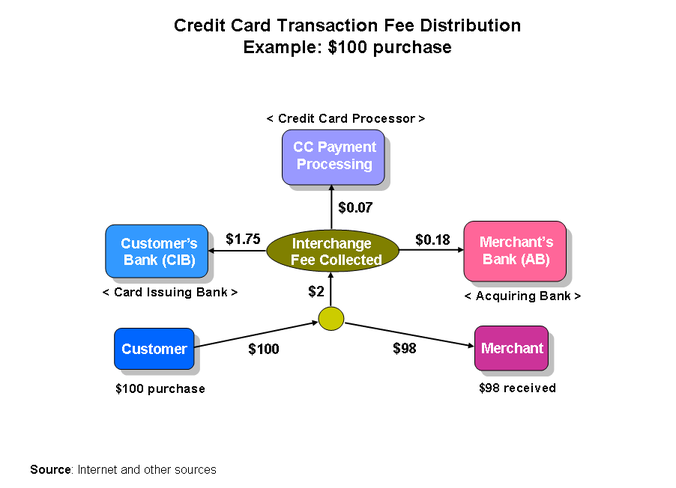
Once the credit card transaction goes through – funds are transferred from the customer’s bank to the merchant’s bank. Banks and credit card companies then share a “cost of transaction” fee called an Interchange Fee.
Figure 3 shows an example of how the present credit card fee model dsitributes a $100 purchase amongst the present ecosystem stakeholders. This is a general model and actual fee amounts may differ between banks, credit card processors and merchants. The credit card transaction fee has been part of the financial transaction process since the national credit card system was formed and will continue after NFC-enabled devices enter into the model.
Figure 3 – Distribution of Interchange Fee
Once the NFC-enabled phone is included in the transaction process, the carrier and a trusted service manager (TSM) are two additional stakeholders added in the transaction processing loop, see Figure 4. An NFC-enabled phone behaves just like a credit card; however, with the NFC-enabled phone over-the-air (OTA) updates are possible and all service providers (in general) in the transaction process may find other revenue generating opportunities that add value.
On the merchant side of the transaction process, the POS terminal is equipped with an NFC chip reader. When the NFC-enabled phone touches the contactless terminal, the terminal is able to pull essential personal identification and account information from the phone, similar to the data contained on the magnetic stripe of a credit or debit card. Because mobile devices will be provisioned with several payment accounts, the phone owner can choose which account to debit the cost of the purchase.
The phone owner may select from the eWallet, a credit or debit card account, or a merchant-specific ”stored value account” – something like a refillable gift card. Because commerce-enabled mobile devices can manage multiple accounts via the eWallet as well as receive OTA updates, this capability puts merchant-sponsored prepayment incentive programs on the same level as major credit and debit cards from the customer’s usability perspective. And that opens new opportunities for merchants to directly build customer loyalty and possibly even lower their (i.e. merchant’s) transaction costs.
Figure 4 – Credit Card Transaction Process with NFC Mobile Payments
Because NFC-enabled phone transactions generally do not change the transaction process for the consumer, it should be easier for the consumer to adopt the technology, thus lowering the learning curve. This transaction has implications for the entire mobile commerce value chain, which includes merchants, POS equipment manufacturers, financial entities, transaction processors, mobile phone manufacturers and carriers.
It opens the door for new entities to enter into the transaction process and additional fees to be garnered. Figure 5 describes the additional fees that could result from the inclusion of a (NFC) mobile payment.
Figure 5 – Proposed Monetary Flow After NFC Mobile Payments Is Introduced
Mobile commerce, or m-commerce, offers significant revenue opportunities (for the entity/ies that accept the TSM role) in the form of provisioning costs and potentially higher-priced data plans to customers. Revenue from advertising carried over the network and additional revenue from transactions are part of the new model as NFC-based phones become available. As the financial transaction process has gone through a number of phases, its “value proposition” has evolved, increasing the opportunity for mobile commerce services, as described below:
Phases in the Financial Transaction Process
•Phase 1: Plastic card/magnetic stripe
•Phase 2: Contactless payments using NFC chip in plastic card
•Phase 3: NFC mobile payments, advertising and promotions
Value Propositions
•Value proposition of Phase 1:
oConvenience
oAlternative to carrying cash
•Value proposition of Phase 2:
oReplaces cash faster
oMoves lines faster
oFirst step towards alternative payment option
oIncreased customer loyalty
oAdded security
•Value proposition of Phase 3 (in addition to phase 2):
oHigher usage of (digital) cards
oLow cost alternative payment options
oNew customer acquisitions
oHighly efficient promotion programs
oTargeted coupon issuance and redemption
oTailored product and services information dissemination
Carriers have an opportunity to be the first mover, or lead, in this NFC-enabled phone market. A key financial measure for carriers is Average Revenue Per User (ARPU), which is the overall revenue divided by total number of users. A fundamental business strategy for carriers is to increase ARPU, and mobile commerce provides an opportunity to do just that.
As the financial transaction process matures from Phase 2 into Phase 3, so does the evolution of several possible ecosystem models that illustrate the administration of the OTA information and role of the TSM. Each model would be based on the geographic location of the service, and as the models evolve so will the opportunity to increase the ARPU. The carriers, handset OEMs (e.g. Apple, RIM and Motorola) and financial institutions, may have a mixed role in managing the transaction. Three possibilities are:
•Self-managed: Carriers, financial institutions and OEMs will self-administer their NFC trusted services
•Cooperative: Other carriers, financial institutions and OEMs will outsource their NFC trusted services to an existing or new ecosystem players
•A developed NFC environment: Carriers and OEMs will outsource some of their NFC trusted services to multiple ecosystem experts
Because carriers provide the wireless link to the handset owner, they also have a greater influence in determining how the additional revenue is generated and shared. There are several vital questions to consider: what new services form the basis of NFC business model revenues, and will mobile commerce increase ARPU enough to offset the added cost of NFC-enabled handsets? The following is a list of new services to that could generate additional ARPU:
•Provisioning – fees per download
oSecure download of credit, debit, prepaid, loyalty, tickets, transit
•Card Services – fees per event/action
oSuch as lost and stolen management
§Remote card deletion when lost phone is reported
§Re-issuance to new phones
oReissuance on card expiration
•One-to-One Marketing – OTA postage fees
oPersonalized coupons, promotions, rewards, and advertising
•Smart Posters – data air-time fees
oContent delivery based on user tapping NFC-enabled (smart) posters
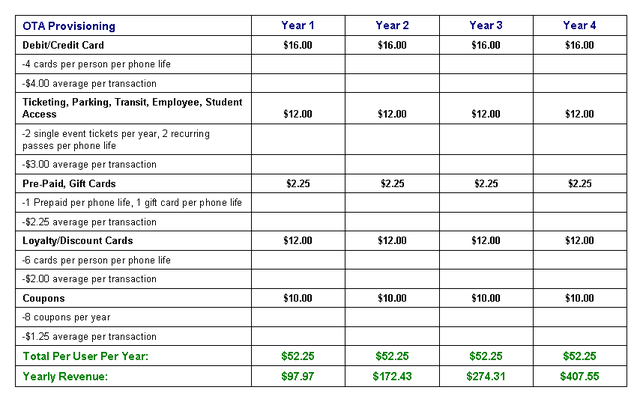
The “increased ARPU” value is somewhat unknown because until mobile commerce catches on – becomes “sticky” – a percentage of those mobile devices purchased probably will not be activated for mobile commerce and therefore won’t help raise ARPU immediately. Financial entities pay fees to have their cards and coupons activated – Existing Solution Fees – in Table 1. Now carriers (and TSMs) could use OTA provisioning as the vehicle that drives the additional (delta) ARPU by charging more for card and coupon activation. Costs in this model are estimates:
Source: Various sources from Internet
Table 1 – Estimated Costs for OTA Provisioning
The categories in Table 1 are the “most likely” categories that reflect the present use cases for non-cash or non-check (i.e. credit or debit card) transactions. And as mobile payments mature and become the norm with consumers and prosumers in the coming years, other or new categories will also become valuable ARPU drivers.
For the above categories and their given cost assumptions, to determine the total yearly revenue derived from OTA provisioning, the user base of NFC-enabled phones along with their enablement and utilization should be considered. Table 2 reflects the calculation for Years 1 through 4, as the number of subscribers, enablement and utilization grows.
Source: Various sources from Internet
Table 2 – Estimated Revenue for OTA Provisioning
Table 3 depicts the Delta Yearly Revenue. There is potentially over $206 million in additional revenue in Year 4 with a NFC user base of 7.2 million (60M Subscribers x 30% NFC Enablement in Phones x 40% Consumer Utilization).
Source: Various sources from Internet
Table 3 – Delta (Increase) in Estimated Revenue using OTA Provisioning
Assumptions (2 year phone life-cycle) for Tables 2 and 3:
Year 1: 50M subscribers, 15% NFC Enablement in Phones, 25% Consumer Utilization
Year 2: 55M subscribers, 20% NFC Enablement in Phones, 30% Consumer Utilization
Year 3: 60M subscribers, 25% NFC Enablement in Phones, 35% Consumer Utilization
Year 4: 60M subscribers, 30% NFC Enablement in Phones, 40% Consumer Utilization
As mentioned, new categories will become relevant as the market matures. Here is a short list of new categories to consider:
•Employee/Student badge
•One-to-One marketing
•New NFC-enabled applications
By including the new categories in the calculation for ARPU revenue, see Table 4, the additional revenue garnered could grow to over $100 million in Year 4.
Source: Various sources from Internet
Table 4 – Estimated Revenue using OTA Provisioning + New Category Revenue
Comparing Table 5 and Table 3 shows that the Delta Yearly Revenue plus New Categories Revenue could grow to over $308 million in Year 4, up from about $206 million, for a NFC user base of 7.2 million (60M Subscribers x 30% NFC Enablement in Phones x 40% Consumer Utilization).
Source: Various sources from Internet
Table 5 - Delta (Increase) in Est. Revenue using OTA Provisioning + New Categories
Assumptions (2 year phone life-cycle) for Tables 4 and 5:
Year 1: 50M subscribers, 15% NFC Enablement in Phones, 25% Consumer Utilization
Year 2: 55M subscribers, 20% NFC Enablement in Phones, 30% Consumer Utilization
Year 3: 60M subscribers, 25% NFC Enablement in Phones, 35% Consumer Utilization
Year 4: 60M subscribers, 30% NFC Enablement in Phones, 40% Consumer Utilization
It is clear that the incentive for carriers to develop and launch NFC-enabled services can provide additional ARPU. This is just one model and other categories, fees, number of users/subscribers, and NFC enablement and utilization will vary for other models. Since carriers could generate additional ARPU, will merchants, banks and credit card companies also benefit, either directly through increased transactions and transaction efficiency, or in the sharing of revenue by the carriers? All stakeholders will benefit from NFC-enabled mobile payments and a revenue distribution model will develop as the ecosystem evolves. For the NFC-based mobile payment market to thrive, however, merchants need to install contactless terminals.
Contactless payment terminals present a somewhat different challenge for merchants. Although they are not significantly different in cost compared to standard credit or debit card readers, traditional card readers cannot be retrofitted with NFC capability, which means that merchants will need to invest in new equipment to support mobile purchases.
IMS Research predicts that the number of locations worldwide accepting contactless payments will grow to over 12.5 million by the end of 2013. Figure 6 shows an estimated growth of NFC-enabled POS terminals relative to non-NFC POS terminals through 2013 (in North America only). There are presently about 600,000 contactless POS terminals and about 13 million non-contactless POS terminals at merchant stores – an installed base of about 13.6 million (at end of 2009).
Source: Various sources from Internet
Figure 6 – POS Terminals in North America
By end of 2013, there are estimated to be nearly 3.6 million contactless terminals and about 11 million non-contactless terminals at merchant stores – an installed base of nearly 14.6 million. Figure 6 shows growth in the total number of installed terminals of about 1 million over four (4) years, and about 2.9 million contactless terminals will be added in that same period.
Higher-end contactless terminals that allow the consumer to swipe or tap their cards or mobile devices, enter their PIN or signature, respond to prompts and be exposed to real-time offers and promotions through its LCD display typically cost about $550 each. Lower-end contactless terminals typically cost about $350. The cost for installing new terminals by the merchant isn’t high and shouldn’t be a barrier.
However, the lack of incentive or initiation by merchants to more aggressively upgrade to contactless terminals could change as more and more consumers begin using NFC-enabled phones (as well as contactless cards).
Which merchants are inclined to upgrade sooner than later? There are three levels of merchants, with a tiered breakdown of each merchant shown in Figure 7. The numbers are taken from Figure 6 and further specified. Tier 1, Tier 2, and Tier 3 categories are defined as:
Figure 7 – POS Terminals in North America by Merchant Category
Each Tier will have approximately the same absolute growth over the next several years as merchants choose to upgrade to contactless payment terminals and new enterprises open for business. It’s not difficult, however, for merchants to recover this investment.
Because mobile transactions are faster than cash or card transactions (as mentioned above), more customers are processed (e.g. move through the checkout lane) in a given period of time, raising the operational efficiency of the business. Why haven’t more merchants been interested in upgrading to contactless payment terminals to take advantage of the contactless cards (installed based), and will they upgrade once the upcoming new NFC-enabled phones become available?
A barrier could be cost – there is some premium for an NFC-enabled payment terminal. Another possibility it that most merchants who understand the technology have already started to use it, or there isn’t a need to reduce the queue time to speed the transaction. Also, at this time the majority of merchants may not see enough customer demand (or requests) to use a contactless card, something the credit card companies can be more proactive to promote. Optimistically, NFC-enabled phones will change that circumstance.
As the benefits to consumers become evident through aggressive (gorilla) marketing and promotional campaigns by terminal suppliers, carriers and financial institutions, in time the rate of adoption of (both attended and unattended) contactless terminals will increase, exceeding the present market forecast.
As mobile payments rollout globally, the role of managing the accounts and OTA updates will become more important. The role that provides this breadth of account management service for mobile devices is more involved than traditional credit and debit card processing. And many of the stakeholders in the mobile commerce ecosystem want to control that role. Ideally, the candidate for fulfilling the role may be an entity (or entities) with relationships to financial institutions, handset manufactures and carriers, or some combination there of.
In North America, the ISIS joint venture may be the answer to this pending quandary – they’ve pulled together the key partners who have experience in contactless payments and who can contribute to managing the mobile commerce ecosystem. In Japan, DoCoMo was instrumental in establishing a TSM role, called FeliCa Networks. Nokia had invested in a TSM joint venture with Giesecke & Devrient in 2006, called Venyon, and exited it in 2009 by selling their share to Giesecke & Devrient. Europe has a number of other TSM-oriented suitors: Gemalto, Obethur Technologies and Zapa Technology, to name a few.
The NFC Forum released a white paper in 2008 that describes the NFC ecosystem and the need and benefits for a TSM. A partnership that is comprised of the key stakeholders should determine and facilitate the cell phone-enabled NFC transaction process so it works smoothly and seamlessly. There are many options, and as the mobile payment ecosystem matures, so will the TSM role and the addition (and sharing) of revenue generating services.
In March 2004, Nokia, Philips Electronics and Sony establish the Near Field Communication (NFC) ForumB to enable the use of touch-based interactions in consumer electronics, mobile devices, PCs, smart objects and for payment. NFC technology evolved from a combination of contactless identification (i.e. RFID – Radio Frequency IDentification) and interconnection technologies.
At the time, NFC technology was standardized in ISO-18092, ECMA 340, and ETSI TS 102 190. NFC was also compatible to the broadly established contactless smart card infrastructure based on ISO-14443A, Philips’ (now NXP) MIFARE® technology, as well as Sony’s FeliCa™ card. The reason that NFC technology has its roots in ISO-18092, ISO-14443, MIFARE and FeliCa, is that these standards and technologies were the basis for smart cards, which were first used in the 1980s and 1990s in Europe and Japan. And this technology was derived from RFID technology that was invented in 1945 by Léon Theremin as an espionage tool. The first application of the RFID technology, though, was invented in 1973 by Mario Cardullo.
The original business plan presented by Mario to investors in 1969 showed use cases forC:
One could say that Mario was ahead of his time, leading the way for present day applications; and many of today’s applications are included in his original business plan. The original smart card technology, called automated chip card, was invented in 1968 German rocket scientist Helmut Gröttrup and his colleague Jürgen Dethloff. The first mass use of the card was as a Télécarte for payment in French pay phones, starting in 1983. In 1992, the Carte Bleue debit cards became available in France. Customers inserted the card into the merchant's point of sale (POS) terminal, then typed the PIN before the transaction was completed. Only very limited transactions (such as paying small highway tolls) were processed without a PIND.
Smart-card-based "electronic purse" systems, which stored funds on the card so that readers do not need network connectivity, entered service throughout Europe in the mid-1990s. These cards could also be considered the first version of pre-paid cards, and are similar to SVC (stored value cards), which are used in their magnetic striped version in the North America today by Target, Best Buy and similar stores as gift cardsE.
With the introduction of smart-card-based Subscriber Information Module (SIM) used in GSM mobile phones in Europe in the 1990s, smart cards along with cell phones became widespread. To further smart card usage, MasterCard, Visa, and Europay agreed in 1993 to work together to develop the specifications for smart cards as either a debit or a credit card. The first version of the EMV system was released in 1994.
Cash (or coin) was a means used to make transactions for many centuries. Bills evolved as a way to make transactions so large amounts of gold or silver coins had to be carried with the person. And checks, which were simply another form of a bill (of exchange) to make non-cash transactions, have been around since the 9th century.
The first charge card was created in 1946 (as the story goes) and was used only for local purchases. In February 1950, a charge card for general use was created after a client had forgotten his wallet while dining out, and thought this would be useful to have. This charge card was called Diners Club Card, and by the end of 1951 there were over 20,000 cardholders. It took nearly 20 years from the time the first credit (or charge) card was issued in 1946 until the formation of an “open-loop” credit card system – enabling interbank cooperation and funds transfers.
Electronics payment terminals using a credit card with a magnetic stripe was first introduced in 1979 by Visa. MasterCard also started offering magnetic striped credit cards in the same year. In 1983, VeriFone introduced the ZON terminal. In 1982, Hypercom entered the electronics payment terminals market. Then, in 1994 Lipman Electronic Engineering entered the market with the Nurit line of processing terminals. Today, MasterCard PayPass, ViVOtech and USA Technologies and a list of others also provide electronic payment terminals. The electronic payment terminal business includes: wired and wireless, attended and unattended terminals.
A study on electronic banking conducted by the Federal Reserve in 2004 concluded that in 2000, 41.9 billion (or 57.8% of the total) non-cash transactions were by check, compared with 30.6 billion (or 42.2% of the total) were by electronic payments. By 2003, the number of electronic payment transactions totaled 44.5 billion (or 54.8% of the total), while the number of checks for non-cash payment transactions totaled 36.7 billion (or 45.2% of the total). 2003 was the first year that electronic payment surpassed check payment for paying bills.
In addition, electronic commerce (or e-commerce), fueled in part by Amazon (founded in 1995) and then by PayPal (founded in 1998), further accelerated electronic payment transactions. The decade of 2000 has shown a significant transition regarding how people elected to pay their bills. It was nearly 57 years since “credit cards” were introduced in 1946 and nearly 24 years since “magnetic striped credit cards” were first available in 1979, that electronic transactions overtook check transactions to pay bills.
Contactless (wireless) electronic payment transactions using your mobile device is on the verge of exponential growth as standards and contactless technology has evolved over this past decade. Near Field Communication (NFC) is the contactless technology that has made its way into the forefront and will be integrated into “soon to be released” handsets for making mobile payments, also called m-Payments.
According to a report by Research and Markets, in 2009 the value of all mobile payment transactions in the U.S, including SMS-type transactions, was $5.2 billion, constituting 6% of the global value of mobile payment transactions. This is expected to reach $56.7 billion in 2015, growing at a CAGR of 49.2%. The market share of the U.S. in 2015 is forecasted to reach approximately 10.6% of the global mobile payment transactionsA. NFC-enabled phones will be a significant contributor to this market growth.
Carriers, handset manufacturers, banks, merchants and credit card companies are stakeholders that have an interest in bringing this technology to the market, and have been conducting trials in North America for several years. Now with the formation of ISIS, a joint venture (JV) between AT&T, T-Mobile, Verizon, Discover Card and Barclays, and the announcements in 2010 of several handset manufacturers supporting NFC in certain models, the initiative is moving forward and NFC-based mobile payment is imminent. Sprint Wireless, however, is not presently part of the ISIS partnership and may be heading down a similar yet separate path.
Sprint Wireless is offering a Sprint Mobile Wallet that will be preloaded on Sprint Wireless phones beginning sometime in 2011. MasterCard and Visa, both missing from the ISIS partnership as well, will provide credit card infrastructure support along with Amazon Payments. CardinalCommerce is hosting/facilitating the transactions between the customer and the merchants for Sprint Wireless. With carriers in North America now forging ahead with NFC-enabled phones, it’s now up to the consumer to start taking advantage of this technology’s value proposition – secure payments, flexibility and convenience.
The credit card industry for over nearly six decades has progressively evolved the financial transaction system, making credit card and then online banking a safe and secure purchasing vehicle for consumers – quite a feat that has paved the way for the introduction of mobile payments using NFC. The new phase we’re entering into now is to convince the consumer (again) that conducting a financial transaction for goods and services is easy, safe and secure, but using the mobile phone rather than a “piece of plastic” (or paper).
As the digital age continues to influence our daily lives and “apprehensive” consumers begin to use mobile payment technology, the adoption rate for mobile payments will increase. What is the market potential for mobile payments and what is the value proposition that will influence and motivate the ecosystem?
I have over 18 years of mobile and RF/wireless marketing, management and product development experience in systems, apps and consumer electronics products. I follow technological convergence, market trends and ecosystems, and write about them. My work experience has been with wireless and mobile start-ups as well as several Fortune 500 companies in the semiconductor and consumer electronics markets - Palm Smartphone Marketing, SanDisk A/V BL, and Philips Semiconductors (now NXP).